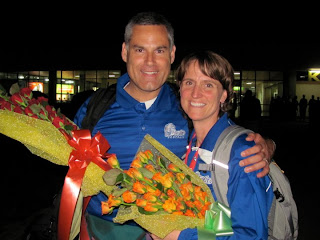
A 60-something year-old University President from Iowa heading to Tanzania to attempt to climb 19,340 feet to the summit of Mount Kilimanjaro?

That's me. David Maxwell, president of Drake University in Des Moines, Iowa.

I will be accompanying members of the Drake University Football Team to Tanzania as part of the Global Kilimanjaro Bowl — the first collegiate game of American football to be played on the African continent.

As part of this experience we will engage in service projects — including building a wing on an orphanage for children of AIDS victims, building housing for teachers at a school outside of Moshi, clearing land for school playgrounds, and working with a local organization that serves orphaned street children.

We will cap the trip with a trip to the summit of Mount Kilimanjaro with our partners (and competitors) the CONADEIP All-Stars from Mexico.

Thursday, May 19, 2011

A wonderful beginning

Both teams practiced at a sports club facility out near the airport at 9 this morning. Given the lack of sleep, the eight-hour time difference they are still adapting to and the altitude of 6,000 feet, I'm sure it wasn't either team's best workout.

After the practice, about 200 local schoolchildren came in for a football clinic. Many of them are very gifted athletes and some had played rugby. For the latter group, American football was not so weird. After running the kids through a variety of "drills," all designed to be fun with a lot of yelling and fist pumping, they were divided into teams and played a 15-minute game of "ultimate football."

In the Tanzanian kids' version, this seems to mean that everyone runs around the field throwing the ball and/or trying to intercept it, and when the game is over, one of them asks, "So how do you score points?"

The photo of a young woman in traditional Muslim attire catching a football with a determined look on her face is a wonderful metaphor for the trip. The kids learned a lot about football and us today. We still have a lot to learn about them, but today was a wonderful beginning.

After the "games," I noticed two of the CONADEIP players from Mexico teaching a few kids how to kick field goals. They were wonderful -- silly, serious, exalting in their success and falling down laughing when they missed (which was most of the time).

The kids noticed me and politely demanded that I hand over my sunglasses, and the posing began. After each photo, the kids gathered around the camera to judge whether or not my picture was worthy of their theatrics, or if I had to reshoot it to their satisfaction.

The pictures of the players (Mexican and American) with the school children say it all -- just look at their faces ... another sunrise...

Clinic: Day 1

A member of the CONADEIP All-Stars teaching place kicking

Me with Goodness. Yes, that's her name. She and I threw a football around for 20 minutes. She's got an NFL arm...

Drake Athletic Director Sandy Hatfield Clubb and friends

Arrival and Clinics

The Drake contingent arrived safely in Arusha, Tanzania, along with the CONADEIP All-Stars from Mexico and representatives from Global Football. The teams settled in quickly and are already engaged in clinics, teaching the basics of American-style football to local children.

Pictures below are a small sample of those already posted to the Kili Bowl facebook page.

Drake Head Football Coach Chris Creighton and Athletic Director Sandy Hatfield Clubb
upon arrival in Tanzania.

Drake players (from Left) defensive back Matt Buckley, defensive back Nick Chenier, linebacker Jim Nelson with Masa'i warriors.

ITV (game broadcaster) interviews Drake defensive end Padraic O'Connell.

Action from the football clinic.


Wednesday, May 18, 2011

Becoming the Mountain

More than halfway to Tanzania — five hours to go before we land. The CONADEIP all-stars joined us in Amsterdam, as did our players who flew from Minneapolis. Both teams immediately introduced themselves and started chatting — their worlds are expanding already.


Everyone who talks to us on the journey is amazed at the magnitude of what we're doing. They've never heard of anything like it — with good reason since there never has been anything like it — and they are extremely impressed with the trip’s purpose. Members of the flight crew on this plane are going to try to drive to Arusha tomorrow to watch the sports clinics!


At Schipol Airport, one of the players confided to me what I knew already, but it was so good to hear it coming from him. He said, "You know, we're all really excited about the game on Saturday, and we're competitive and want to win, but that's not really what this is all about, you know? It's just a small, important part of a very big thing."


It occurred to me in my jet-lagged state that this trip has an interesting conceptual polarity. There's the aggressive, competitive pole — we're playing a milestone game and we want to win; we want to conquer a mountain. At the other end, there's the engaged, accepting pole: we are engaged in service, along side our competitors; we are learning about the “other.”


For months as I’ve trained for the climb, I’ve seen the mountain as a part of the competition — I've been steeling myself to conquer the mountain, to defeat it and proclaim victory at the top (assuming that I'll have enough breath to proclaim anything). But as I near Tanzania and the mountain, it has dawned on me (belatedly, but better late...) that I’ve been foolish. I will never "defeat" Mt. Kilimanjaro — it will be there long, long after all of us, unchanged (except for the disappearing snow, thanks to global warming) awaiting all those who dare to challenge it.


Rather than seeing the mountain as an obstacle to be defeated, I have to find a way to become part of the mountain’s being for six days, to show it its due respect, to find a way for it to accept me, to allow me to reach its summit and see the sun rise over the crater. Ultimately, it becomes a symbol for everything we will do in Tanzania — we must become an unobtrusive, welcome and respectful part of the whole that is already here, and we'll see the sun rise every day.

Drake's football team over Africa

Just a few more hours...

Tupande Kileleni! — Let's Climb to the Summit

Sitting in the departure lounge at O'Hare, waiting for our flight to Amsterdam (after a 7-hour bus ride from Des Moines with Heather Creighton wearing her blue wig). I'm traveling with some of the coaches, their spouses and a few other staff; Coach Creighton and the team are flying out of Minneapolis. Tomorrow morning we'll all meet up with the Mexican contingent in Amsterdam for the 9 1/2-hour flight to Tanzania.


All of this has been a bit surreal — and it is just beginning. It's hard to believe this journey will end tomorrow night in Equatorial Africa, not one of my usual flights to D.C. or Florida.


Just getting to this point has been a long journey as well: three months of training at 5:45 a.m., three days a week with Lindsey Anderson, the performance enhancement director at Physiotherapy Associates (and Shawn Johnson's fitness guru); an hour a day (most days) split between inclined treadmill and Stairmaster with my backpack on, loaded with two gallons of water; and running (which I've been doing for 30 years) whenever I can.


My wife, Maddy, has been a saint accommodating this insane schedule on top of the usual demands of my job and her many responsibilities, including taking Gus (our one-year-old Goldendoodle) out at 5 a.m. while I stumble off to work out. All of this will help getting up the mountain, but altitude tolerance is an unknown for everyone — even if you made it up once with no problem, the next time can be different.


But most of all I, like everyone else I think, cannot wait to immerse myself in the newness of a place I've never been before, to engage with new ways of thinking about the world, to find out what we — the United States — look like from another vantage point in the world.


No matter how many places I've been over all too many years, the excitement of traveling never fades. I'm sure that all of us will come back changed by the experiences — the people, the views, the mountain — as well as the intellectual, emotional and physical challenges we’ve put ourselves through.

But first I have to try to sleep jammed into a coach seat for 9 hours ... and that's only the first flight!


Tupande Kileleni!

Monday, May 16, 2011

Why am I doing this?

I’ve been asked repeatedly over the past few months why I’m going to Tanzania—sometimes by people who think I’m out of my mind (and I’m happy to prove them right). But I know why we’re all going: we’re going because we never have. We’re going because we’ve never helped build a wing on an orphanage in a developing country. We’re going because many of us have never climbed a mountain—certainly not one this high. We’re going because almost all of us have never been in Africa, which means we are incomplete as human beings—we are missing an essential part of the human experience that can help make us whole. We are going because it will enhance our “connectedness to the world around us.” We are going because we will share the experience among ourselves, and with our friends from Mexico, of having our worlds explode wide open. And I am also going because I can’t wait to share the experience with my sons.


For me personally, even though I’ve spent time in roughly 30 countries around the globe, this trip will widen my world. It will deepen my world. It will make my world more complex, more rich, more nuanced, both more understandable and more mysterious. But those consequences are not ultimately for my personal benefit or gain (although I will benefit immensely) — they’re what all that will enable me to do. For more than four decades, I have been in a profession that gives me the opportunity to make a difference, to make it matter that I was here: I am a teacher, I am a mentor. My purpose is to help others realize their dreams. In my current position as president of this wonderful institution, I have a powerful responsibility to demonstrate with my words and deeds to all of our constituencies, internal and external, what Drake is and what we the Drake community aspire to be. I have to be able to live who we are, to live our expectations of our students. I have an even more powerful responsibility to do everything that I can, along with everyone who serves Drake, to ensure that Drake is what our students and faculty expected when they came to Drake—that they can find their dreams and live them.


If this trip and all that it entails lives up to my expectations, it will make me better able to serve—and in doing so it will give my life even more meaning; it will matter even more that I was here, that there was a purpose for me because of what I will be able to do for others.